
Earn With Digital Marketing
Introduction
Digital marketing is one of the most accessible and powerful ways to build income online today. Whether you are a student, a stay-at-home parent, a full-time employee or someone between jobs, digital marketing offers flexible paths to earn — from freelancing and affiliate sales to building your own online business. This article is a practical, step-by-step teacher-style guide that explains what digital marketing is, how to learn it, the first actions to take, and at least three dependable income sources you can start using right away.
1. What is Digital Marketing?
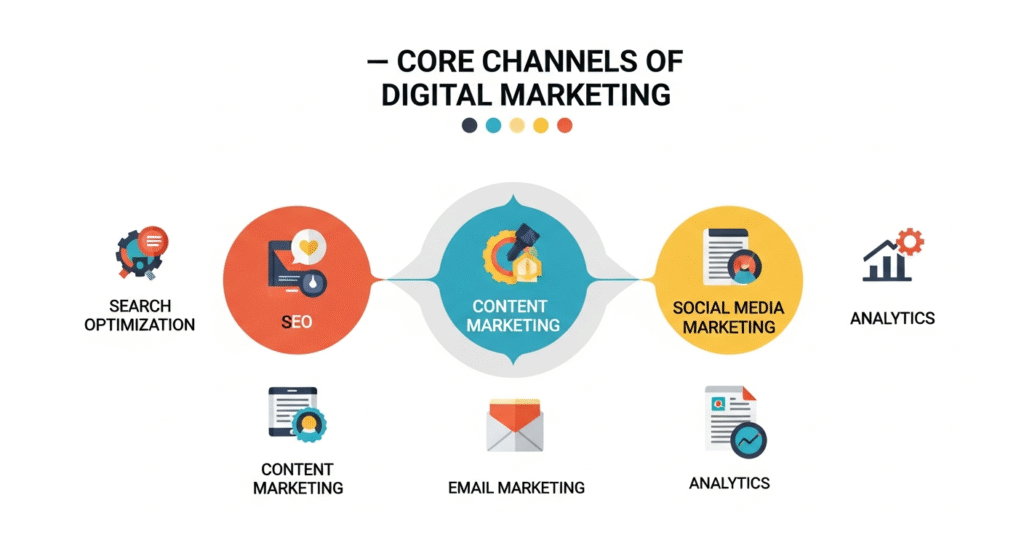
Digital marketing is the practice of promoting products, services, or content through digital channels — such as search engines, social media platforms, email, websites, apps, and online advertising networks. Unlike traditional marketing (TV, radio, print), digital marketing is measurable, targeted, and often low-cost. The major disciplines inside digital marketing include:
-
SEO (Search Engine Optimization): Getting free organic traffic from search engines.
-
Content Marketing: Creating helpful articles, videos, podcasts or other content to attract and retain an audience.
-
Social Media Marketing (SMM): Building and engaging audiences on platforms like Instagram, Facebook, YouTube, LinkedIn, or TikTok.
-
Paid Advertising (PPC): Buying traffic through ads on platforms like Google Ads, Facebook Ads, YouTube, or native ad networks.
-
Email Marketing: Nurturing leads and customers through targeted email sequences.
-
Affiliate Marketing: Promoting other people’s products and earning commissions on sales.
All of these work together: great content fuels SEO and social sharing; email keeps visitors coming back; ads speed up results; and affiliates help scale promotion.
2. How to Learn Digital Marketing — a Practical Roadmap
Learning digital marketing is a marathon, not a sprint. The right approach blends structured learning with hands-on practice.
Step A — Build a foundation (2–4 weeks)
-
Understand core concepts: Start with clear basics — what SEO, content marketing, PPC, and email marketing are and how they fit together.
-
Free resources: Use high-quality free resources such as Google’s Digital Garage, HubSpot Academy, and beginner YouTube channels that demonstrate practical workflows.
-
Follow a single learning path: Don’t hop between topics. Choose either SEO/content or paid ads/social media first — both are solid entry points.
Step B — Hands-on practice (4–8 weeks)
-
Create a small project: Launch a simple blog, a niche website, or a social channel on one platform. Real work beats theory.
-
Set measurable goals: Example: publish 12 blog posts in two months, or get to 1,000 followers on a new Instagram in three months.
-
Use tools: Start with free or low-cost tools — Google Analytics, Google Search Console, Canva for creatives, and Mailchimp for emails.
Step C — Learn by solving problems (ongoing)
-
Analyze results: Check traffic, engagement and conversions. What works? What doesn’t?
-
Iterate: Improve on headlines, content structure, ad copy and targeting.
-
Join communities: Reddit subreddits, Facebook groups, and marketing forums teach practical tricks and answer real problems.
3. The First Step: Your First Practical Assignment
If you are ready to start today, do this single assignment — it will teach you more than reading ten articles.
Create a single landing page and drive traffic to it.
What to do:
-
Pick a topic or offer: Solve a small problem (e.g., “10-minute home workout plan” or “best headphones under $50”).
-
Write one long-form article (800–1,200 words) or record one short explainer video (2–4 minutes).
-
Build a landing page: Use WordPress, Carrd, or a site builder and make a clear headline, benefits, and a CTA (email signup or affiliate link).
-
Drive traffic: Share it in relevant social groups, or run a small paid campaign (even $5–$10) to test messaging.
-
Measure: See how many visitors convert into email subscribers or clicks. Optimize the headline and CTA based on results.
This single loop (create → promote → measure → optimize) is the core cycle of digital marketing and will teach you the highest-value skills faster than passive study.
4. Three Reliable Income Sources You Can Start With
Below are three practical earning channels. You can choose one to start and add the others as you gain momentum.
1) Freelancing (Services)
What it is: Sell marketing services — SEO audits, content writing, social media management, or ads management — to clients.
How to start:
-
Create a simple portfolio page that describes 1–3 services clearly.
-
Offer a low-cost “trial project” to your first clients (for example, a one-page SEO audit for $25).
-
Use platforms like Upwork, Fiverr, or local networking groups to find clients.
Why it works: Demand for hands-on help is always high. Once you have 3–5 case studies showing results, you can raise prices and rely on referrals.
Tips: Niching (e.g., “SEO for local bakeries”) makes finding clients easier.
2) Affiliate Marketing (Promotion)
What it is: Promote products from other companies and earn a commission for every sale or lead generated through your referral link.
How to start:
-
Choose a niche you understand (tech gadgets, beauty, courses, etc.).
-
Create content that helps buyers — honest reviews, comparisons, or how-to guides.
-
Use affiliate programs (Amazon Associates, ClickBank, CJ, ShareASale, or niche SaaS affiliate programs).
Why it works: You don’t need to create a product. With good content and SEO, affiliate pages compound traffic and earnings over time.
Tips: Be transparent with your audience about affiliate links and prioritize trust — recommend only products you believe in.
3) Create and Sell Your Own Digital Products or Courses
What it is: Package your knowledge as an ebook, template, toolkit, or an online course and sell it repeatedly.
How to start:
-
Solve a specific problem in your niche and package the solution (e.g., an Instagram growth checklist or a small course on local SEO).
-
Use Gumroad, Teachable, or Sellfy to host and sell the product.
-
Use email marketing and social media to reach potential buyers.
Why it works: Margins are high for digital products, and once created, they scale without significant extra effort.
Tips: Start with a small product, collect feedback, then expand. Offer a money-back guarantee to remove friction.
5. Putting the Pieces Together: A 90-Day Action Plan
Weeks 1–2: Learn basics + pick a niche. Weeks 3–6: Create your first landing page and publish content. Start freelancing outreach or join an affiliate program. Weeks 7–12: Run small ad tests, collect email subscribers, improve conversion rates, and create a small digital product or scale freelancing.
At the end of 90 days you should have:
-
A working landing page or blog.
-
At least one paying client or initial affiliate revenue.
-
An email list with subscribers you can nurture.
6. Mindset, persistence and ethical practice
Digital marketing rewards patience and curiosity. Results compound: your content and SEO efforts grow over months. Always be ethical — don’t use spammy tactics, respect user privacy, and disclose affiliate relationships. Focus on delivering genuine value first; earnings will follow.
7. Resources & Next Steps
-
Free learning: Google Digital Garage, HubSpot Academy, and YouTube creators like Backlinko, Neil Patel, and Ahrefs for practical SEO lessons.
-
Tools to try: Google Analytics, Search Console, Canva, Mailchimp (or ConvertKit), and WordPress.
-
Communities: Reddit (/r/marketing, /r/SEO), Facebook groups for freelancers, and local entrepreneur meetups.
Final thought
Digital marketing is a skill set you can learn with focused practice. Start small, measure everything, and reinvest profits into higher-impact activities. Follow the create → promote → measure → optimize loop, and choose one income source to begin. Within a few months, you can transform curiosity into a dependable, scalable income stream.
If you’d like, I can tailor this article into a step-by-step checklist, a printable PDF, or add two instructional images for the “First Step” and “Three Income Sources” sections — tell me which format you prefer.
Your point of view caught my eye and was very interesting. Thanks. I have a question for you.
Thanks for sharing. I read many of your blog posts, cool, your blog is very good.
MXjogo is fun, nice platform. The graphics are great and the variety keeps things interesting. Worth trying! mxjogo
9999jili, tried it out the other day. Not bad! UI is friendly, games work fast. I will continue to play here.9999jili
777xklogin, simple and convenient login. I saved the website to try it out later. Hoping for good luck. 777xklogin
Your article helped me a lot, is there any more related content? Thanks!
Your point of view caught my eye and was very interesting. Thanks. I have a question for you.
Win678vn, huh? Yeah, I’ve heard whispers about them. Seems like their VN focus is paying off. Good for us local players! The site’s interface is easy to navigate, which is a big plus for me. Worth a look, especially if you’re into the local scene. win678vn
9080betapp sounds app-focused. Mobile betting is where it’s at these days. If you’re looking for a convenient way to bet on the go, give this app a shot and see if it suits your needs: 9080betapp
999jililink, alright! Jili games can be pretty fun. If you like slots with a bit of an Asian flair, this might be your jam. Check it out here: 999jililink
Gents, keen to download the Playtime casino app. Heard its legit. Anyone know if its any good? Is it safe? Check it out at: playtime casino app download.
Where’s the best place for the tc lottery download? Gotta get it quick!
Searching for the Playtime casino app download! Anyone got a reliable source? Want to try mah luck! Find it here: playtime app casino download.
Your article helped me a lot, is there any more related content? Thanks!